Update: Looking for information about virtual queuing? Read our guide to scoping a virtual queuing solution
Ask anyone running a large theme park about keeping guests happy, and they’ll tell you that queuing remains a top issue.
Such an obvious pain point has attracted plenty of solutions over the years, all promising to greatly reduce, or even completely eliminate, queuing from the theme park experience.
None of these systems is perfect yet, though, and the realities of limited ride capacity and large seasonal crowds make a truly queueless experience unlikely.
Even if queuing could be eliminated completely, it’s a matter of debate within the industry whether that would be desirable. Would it kill the anticipation of each experience? Would it affect spending habits? Would it shorten multi-day visits?
Managing expectations
With queuing here to stay, parks must look at ways to minimise its negative impact. So what can be done?
It turns out that if you want to make queuing as pain-free as possible, it’s all about managing expectations.
Anyone who’s been to a theme park on a busy summer’s day knows that there’s nothing more frustrating than being told a ride has a 20-minute wait, only to still be queuing an hour later.
This happens because measuring wait times in real time and reporting them reliably to guests is quite an involved process. Many parks have little or no technology to help, and the result is frustrated guests. Accurate queue times aren’t only important for guests, either. They’re essential information for park operations teams. Without reliable data, it’s impossible to understand ride demand over time and make sound operational decisions.
Wait time monitoring methods
Manual monitoring
The most basic way to monitor queue wait times is to ask ride operators to look at the queue and estimate the wait from experience.
Pros: An experienced operator can report surprisingly accurate times.
Cons: Recording times regularly and communicating them to guests is a challenge without the right tools.
Camera tracking
Camera tracking uses cameras that count people into and out of a queue to work out how many people are waiting. The ride’s throughput can also be calculated, which in turn allows queue times to be determined.
Pros: You can measure ride throughput as well as wait times.
Cons: It’s expensive to install.
Device tracking
Device tracking uses scanning hardware to detect the Wi-Fi and Bluetooth signals given off by guests’ smartphones. The scanners are placed around the queue and report back to a central system for processing.
Pros: Data can be collected from most of the mobile devices guests carry.
Cons: The hardware can be expensive, and modern iOS and Android phones now randomise the addresses they broadcast to protect privacy, which makes counting individual devices less reliable.
Mobile app tracking
Mobile app tracking uses the number of guests with the park’s app on their phones (the install base) to measure wait times. Bluetooth beacons are placed along the queue, and as guests with the app walk past, the app picks up the beacons and reports their progress.
Pros: You can tie wait times back to individual guests for better targeting.
Cons: Only guests with the park’s app installed are counted, so a good install base is needed.
Method comparison
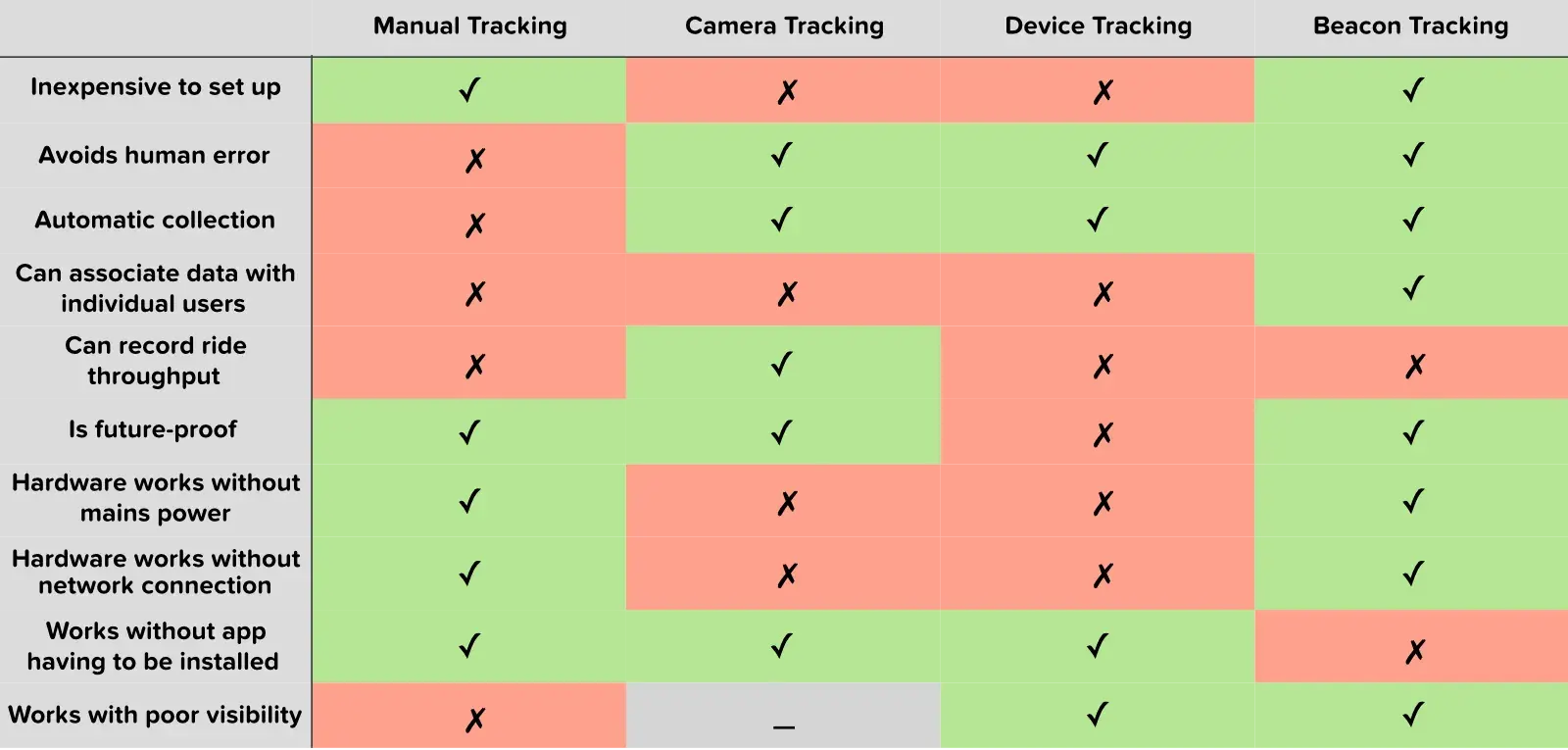
The table below compares what each method can do.
Summary
Queuing is one of the top pain points for theme park guests, and it’s not going away any time soon. Managing expectations is essential to keeping guests happy, and parks have several technologies to choose from when it comes to automated monitoring.
Picking the right queue monitoring solution for your attraction will help manage guests’ expectations and give you an accurate stream of data for operational planning.
Our recommendation
Whichever way you measure them, wait times only help guests once they reach them. The mobile app is where they make the biggest difference: guests can see live wait times across the whole park and decide where to go next. With Attractions.io, ride operators can log wait times, closures and status messages in Connect, our operator console, and updates reach the app and on-site digital signage straight away.
Wait times are also one of the strongest live signals your park has. On our guest experience platform, a long queue can trigger a fast pass offer, and guests already in the queue can be sent relevant messages, such as the option to pre-order lunch while they wait.
Beyond queue times, a mobile app brings many other benefits to operators and guests, so it’s worth reviewing your needs as a whole rather than looking for a fix to one problem. If you’re not sure where to start, our guide on how to launch a successful attraction app covers the opportunities for operations, marketing, commercial and guest services teams.