THE ATTRACTION OPERATOR'S GUIDE TO

How AI will transform the on-site guest experience at your enterprise attraction

Get more from every visit with AI that adapts to each guest and what's happening in your venue.
INTRODUCTION

It's a tough time to run an attraction. Attendance is trending down, and 3 in 5 IAAPA members say revenue has dipped or stayed flat over the past quarter. When you can't count on more people through the gate, growth has to come from the yield of every guest already inside it.

Getting more from each guest means treating them as an individual. And that starts with knowing who they are. Many larger operators are already unifying their guest data into a single view; if that's you, it's the right foundation.

The instinct from there is familiar: route that profile to a CRM, hand it to a campaign team, and have them build the segments, journeys and campaigns. But that playbook was designed for scheduled marketing. It can't reason about one guest, in your venue, at 2pm in the rain, and it doesn’t support genuine one-to-one communication.

AI changes what's possible. An AI decisioning layer can reason over everything you know about a guest and the live state of your venue, and act in the moment with no segments, journeys or rules for anyone to predefine. You can't do that without the right infrastructure beneath it. This guide sets out what that architecture looks like, and how to get there.


Mark Locker
Sandra Torres
Mark Locker,
Founder & CEO at Attractions.io
THE PROBLEM

You know it's her third visit. But you still send her the same message as 3,000 strangers.

It's 2pm and the skies open. Somewhere in your stack, you know Jenny. It's her third visit this year. She has two kids under six. She bought lunch an hour ago. She's standing a minute’s walk away from a dark ride with no wait.

You know all of it. But right on schedule, she gets the same push as everyone else on site:  “Don't miss the 3pm parade! ☀️" — the parade that's just been rained off.

Every system did its job. The ticket was sold, the app sent the push, the data landed in a dashboard. Not one of them did anything for her.

family leaving a theme park early

Spotify acts. Netflix acts. Their bank acts. You broadcast

Guests like Jenny already live in a world where digital tools quietly act on what they know.

Their feed lines up the next-best video. The playlist builds itself. The bank flags the odd transaction before they notice. Against that backdrop, broadcasting the same, pre-set message to everyone on-site feels broken.

Shopping icon

35%

of Amazon's sales are attributed to its recommendation engine
Recommendations by Netflix

£1bn/yr

Netflix's estimated saving in avoided churn from recommending what you watch next
Happy shopify search

Most

of Spotify's listening time now comes from algorithmic discovery, not search
The pattern is consistent:
Know who someone is, what they care about, and what's happening around them — act on it in the moment — and the results compound.

Guest profiles that feed reports and campaigns aren’t enough to keep up in the AI era.

Many venues are starting to feel this pain and working on strategies to reduce it. This might look like creating a universal source of truth in a CDP or CRM.

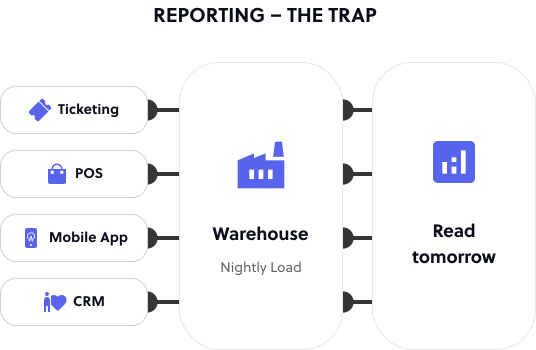
Once you’re set up, the instinct is to route that profile to your segmentation team. In the usual setup it lands in a warehouse, feeds dashboards your team reads next week, and gets sliced into segments for their next campaign.

It’s designed to help a person decide what to do later, not to do anything for Jenny while she's still in the park. The knowledge is unified; it just has nowhere to act.

THE SOLUTION

A decisioning layer does what a segmentation team never could

As a guest moves through their day, each of your systems picks up signals; a booking, a purchase, a ride photo, while others track what's happening across your venue.

Until now that was analysts and marketers building segments, mapping  journeys, writing the rules, and running tests. Even with perfect data, it's slow, broad work: decided in advance, applied the same way to thousands of guests, and capped by how much a team can produce.

A decisioning layer sits on top of the guest profile. AI reasons over everything you know about a guest and the live state of your venue, works out the single best next moment, and recommends it, automatically.

This is what we call Guest Orchestration.

HOW IT WORKS

One loop, running continuously behind every visit

Guest orchestration is that decisioning layer at work. It runs as a continuous loop, for every guest, all day long:
THE SHIFT

From a segmentation playbook to agentic orchestration

The Old Way

✕  Your data: Routed to a CRM and a segmentation team
✕  Targeting: Broad segments e.g. “families with under 10s"
✕  The thinking: Team members hypothesise who wants what
✕  Timing: Scheduled and sent according to the calendar
✕  The workflow: Build → segment → A/B test → repeat
✕  Scale: Capped by your team's capacity
✕  Team: A CRM/segmentation team producing campaigns and workflows

The New Way

✓  Your data: Leveraged directly by AI
✓  Targeting: A segment of one: this guest, right now
✓  The thinking: The agent reasons it out, per guest
✓  Timing: Real-time, sent the moment it matters
✓  The workflow: Sense → decide → act → learn
✓  Scale: 1-2-1 communcation to every guest, all day long
✓  Team: People set the strategy, brand and guardrails
THE PAYOFF

Personalisation that pays off

Personal, in-the-moment relevance drives measurable increases in spend, satisfaction and return visits.
And because the decisioning layer runs automatically, the gains compound across every guest and every venue, without adding to your team.
69%
of customers buy more when the offer adapts to them in the moment
3x
the ROI of mass promotions with personalised recommendations
Higher
customer satisfaction scores on average from AI retail leaders
THE ROADMAP

From a profile to a first-class guest relationship, in five steps:

Number 1

Foundations

Feed your guest profile data in real-time
Number 1

Sense

Bring every system’s data together in one place
Decide icon

Decide

Layer an agentic decisioning layer on top
Act icon

Act

Own the guest-facing channel that acts on your behalf
close the loop

Close the loop

Every interaction feeds back and sharpens the loop
Number 1

Feed your guest profile in real-time

When a guest does something, how fast does it reach their record?

If knowing that they bought lunch shows up tonight, or tomorrow, you've built a reporting system, not a foundation for guest orchestration. To act while the guest is still on site, the profile has to update instantly. That takes two things:
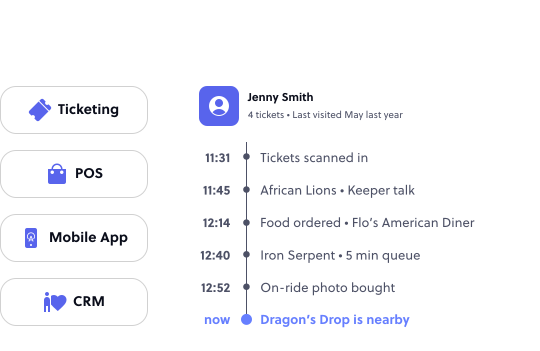
  • Identity that resolves across ticketing, POS, CRM and photography into a single record
  • Event streaming that feeds in as things happen on-site not nightly for you read later.
Number 2

Connect the live state of your venue

A real-time profile still only tells half the story. It knows Jenny is a passholder with two tired kids. Not that it's raining and the coaster she's heading for just closed.

Step two closes the gap: Feed live venue signals into the same layer as the guest profile— weather, queues, capacity, location.

Number 3

Add your AI decisioning layer

With the situational picture in place, you need to turn it into a decision. The old playbook was people; a CRM and a segmentation team slicing audiences and running A/B tests.

The new one is an agentic decisioning layer: an agent that reasons over the profile plus live context and picks the single next-best action for this guest, in the moment.

Number 4

Connect the live state of your venue

A real-time profile still only tells half the story. It knows Jenny is a passholder with two tired kids. Not that it's raining and the coaster she's heading for just closed.

Step two closes the gap: Feed live venue signals into the same layer as the guest profile— weather, queues, capacity, location.

Number 3

Close the loop

The agent doesn't just act and move on, it watches how guests respond. Which suggestions get taken up, which land flat. Over thousands of moments it learns what works for a guest like this, in a situation like this, and does more of it.

The channel matters less than the connection: the action has to flow straight from the decisioning layer to your guest.

Attractions.io makes your stack act

Using a generic platform would mean configuring every data source, encoding every rule and writing every prompt in-house. Our platform is purpose built for attractions, so the equivalent is just turning it on.
Number 1

Branded guest app

The attraction industry's #1 app platform used by 6 million attraction guests
Number 1

Integration friendly

30+ integrations with the systems you use everyday and custom integrations on request
Number 1

AI built for attractions

Trained on 15 years of experience & collaboration with 150+ venues.
Number 1

You're in control

Set the goals, the brand and the guardrails
WHAT'S NEXT?

Book an AI discovery session

We'll talk through your venue’s AI readiness, share the quick wins you can act on now, and show what an AI-personalised visit could look like at your venue.
Book a meeting
