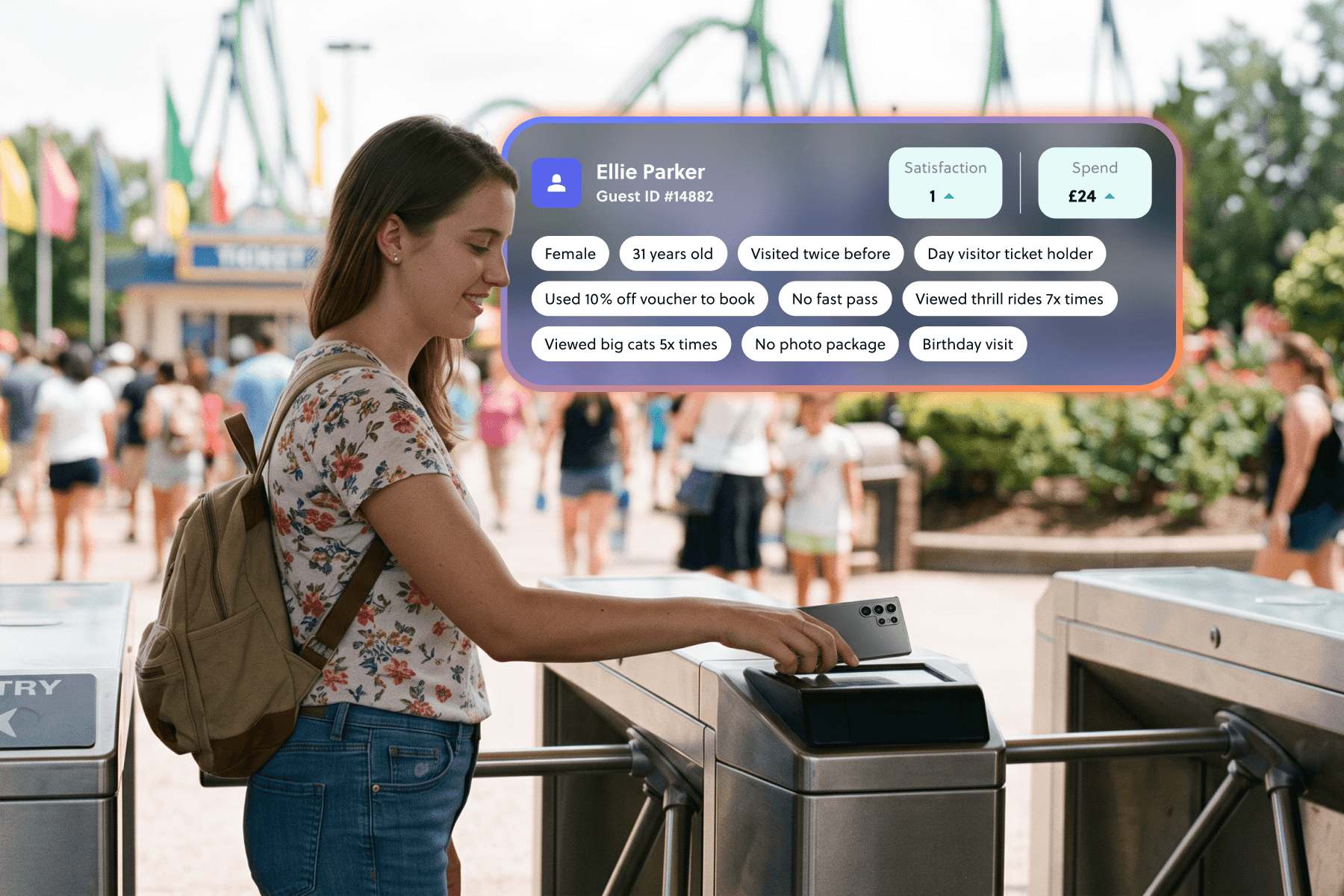
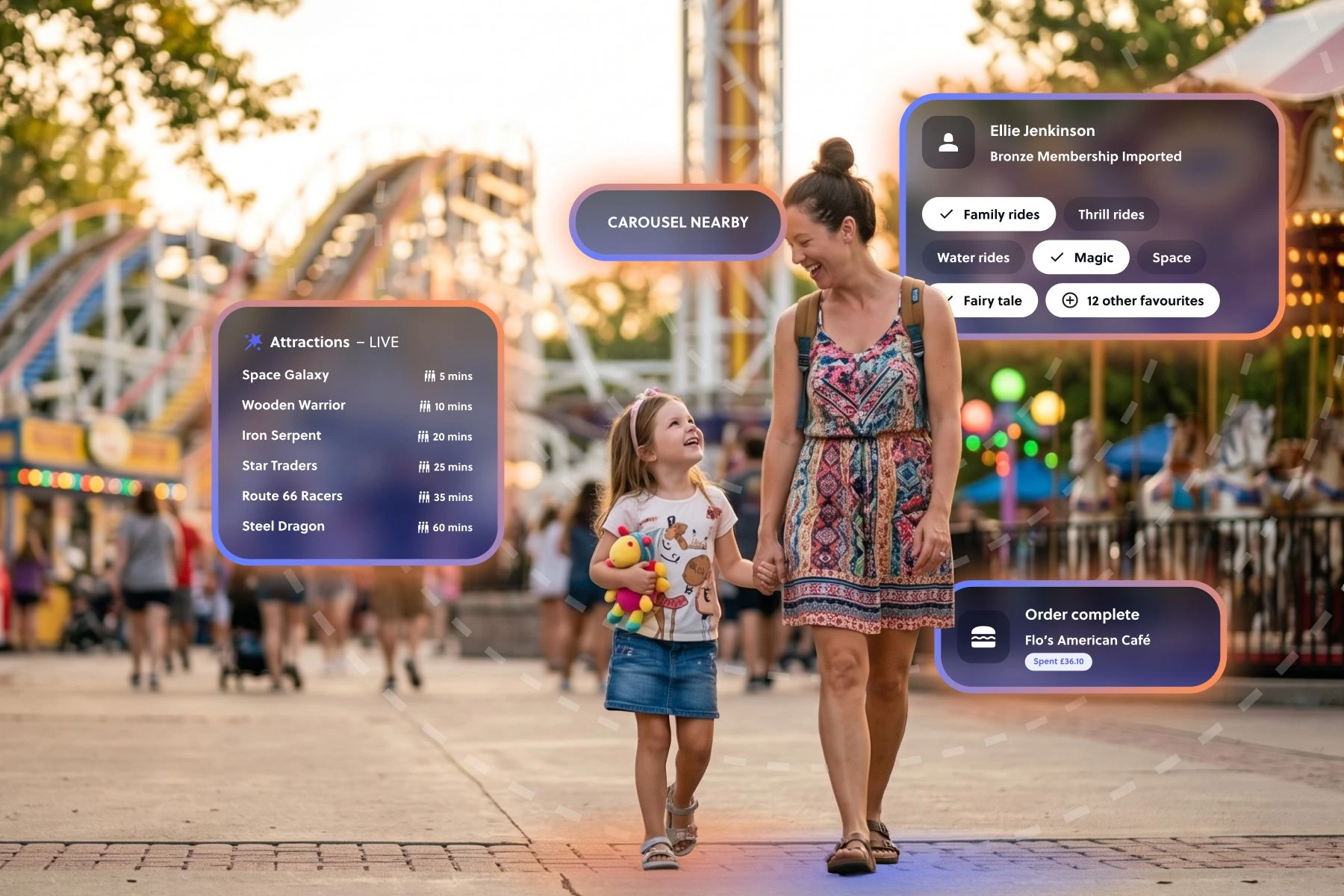
What agentic AI is, what it does and where the real opportunities are for attractions.
.png)
"AI" now appears on almost every attraction's roadmap. But the word "AI" has been stretched to cover almost anything a software tool might do: a website chatbot, a scheduled email, a dashboard with a recommendation in it.
So before an operator can decide what to implement, they need to know what the technology actually is, what it can and cannot do and where it fits in their existing stack and into their venue's operations. This guide is written to help attractions operators do that.
You won't see any sales pitch from us, and this guide's definitions come from established providers and independent analysts. It is up front about where the technology is immature or oversold, and it includes a section on when an agent is the wrong tool. Our own point of view appears in a few clearly marked boxes. We hope that you find it useful.
Up front, it is vital to separate two definitions that we see get tangled together under a generic "AI" banner: generative AI and agentic AI.
Generative AI is the kind most people met first: you prompt a tool like Claude, ChatGPT or Gemini and it generates something back, be that text, an image or code. It responds, and a person decides what to do with the output.
Agentic AI goes a step further. It is given a goal and works towards it, planning the steps, using other software to take actions and adjusting as it goes, with limited human intervention. It does not just describe what could be done, it does it.
A quick test for whether a tool is agentic or generative is asking the following questions: what does the system decide, who decides next steps and does it act?
A chatbot that answers "when does the aquarium close?" is generating a response, not acting. It waits to be asked.
An email tool that sends the same midday message to everyone on site is following a rule set in advance. It fires regardless of what is happening.
A dashboard that flags a queue passing 60 minutes is reporting. A person still has to decide and instigate the fix.
An agent, by contrast, notices the queue is about to climb from 35 to 65 minutes, because a nearby ride went down and a show has just let out, and steers the guests towards something quieter before it builds, perhaps using a push notification or recommendation.
There is no single official definition, but the leading providers converge.
"Agentic AI is an advanced form of artificial intelligence focused on autonomous decision-making and action… [it] can set goals, plan, and execute tasks with minimal human intervention."
Google Cloud
"Agentic AI is an autonomous AI system that can act independently to achieve pre-determined goals."
AWS
"Agentic AI is an artificial intelligence system that can accomplish a specific goal with limited supervision. It consists of AI agents — machine learning models that mimic human decision-making to solve problems in real time."
IBM
Every agent starts from a goal set by a person. From there the same loop repeats: it perceives the current state, decides the best next step, acts in an environment and learns from what happened so its choices improve next time.
Think of an AI agent as a new team member. Each of these is a capability that member either has or lacks.
A single agent can handle a task end to end with its own reasoning, tools and memory, the way one capable employee might manage a guest query from start to finish. A multi-agent system splits the work across specialists instead, such as a planner, a researcher and an executor, usually coordinated by an orchestrator, more like a small team with a manager assigning the right task to the right person.
A bigger team can get more done and each role can be trained and improved on its own. But it is also a bigger team to manage: more handoffs, more chances for a miscommunication between team members to compound into a bigger mistake further down the line. Just like you might expand a team once a single, capable employee has genuinely proven insufficient at the task.
Autonomy is how much of that task you hand over to the agent versus how much you keep for yourself, in the same way you'd decide how much autonomy to give an employee: do they check in at every step, or do they just get on with it? It is not a single on/off decision either; it is a dial that can sit anywhere between the two. A framework from researchers at the University of Washington sets out five levels based on the role the human takes. The framework defines the levels and role names. We have mapped each to how far the human sits from the decision:
User is in control throughout; the agent assists on demand
Rich back-and-forth; both plan and delegate
The agent drives; the user gives feedback and guidance
The user is engaged only for blockers or consequential approvals
Fully autonomous; only an emergency off-switch
Lower autonomy suits decisions that are high-stakes, hard to reverse or regulated, the kind of decision you'd want a new employee to run past you first. Higher autonomy suits high-volume, low-stakes, reversible tasks that are being monitored well, the kind you'd happily leave to a trusted, experienced staff member. In practice, that is the difference between an agent that suggests a queue re-route and one that is allowed to move real crowds without anyone checking first.
An agent is only as useful as two things: whether it can see current information, and whether it can act on it. Without a live connection to your systems, it is like a new starter who has read the manual but has never been shown the till, the booking system or today's schedule. It can talk about the venue, but it cannot perceive what is actually happening in it right now.
Getting that new starter properly set up used to mean a separate induction for every system: one login and one walkthrough for ticketing, another for the POS, another for the CRM. Multiplied across every system and every new hire, that is expensive and slow to scale.
The Model Context Protocol (MCP), an open standard released by Anthropic, now widely adopted and governed by the Linux Foundation's Agentic AI Foundation, works more like a single staff keycard: one common way of connecting that lets the agent reach ticketing, POS, CRM and other systems, carrying context with it as it moves between them.
For anyone scoping AI on the roadmap, the practical takeaway is that MCP turns "we'd need a separate integration for every system" into "we set up access once".
An agent with full context on your venue, and enough autonomy to act on it, is obviously valuable. But most agents are built with software environments in mind, not physical ones.
Software assumes clean, discrete actions: a booking is confirmed, or it is not, a payment goes through or it fails, a guest logs into an e-commerce store and is assigned an ID.
A live venue is messier: queues shift by the minute, weather changes the plan, a ride goes down mid-morning. Those differences shape what an agent can be trusted to do well on the ground, and where a human still needs to stay in the loop.
These are the same conditions that make attractions hard to run well at all: a physical site, finite capacity and a picture of each guest that is always partial. That is why we think autonomy, on its own, is the wrong thing to optimise for when considering how agentic AI can help your attraction. Successful implementation is not an agent that acts without a human but rather one that acts well inside tight physical and safety constraints.
A modern attraction increasingly runs more and more digital tools, which matters because an agent is only as capable as the data and control surfaces it can reach. We see the following stack most commonly in the attractions we work with, and it includes, but of course is not limited to:
Two things follow. Guest data concentrates in the CRM, ticketing, POS and app, the systems an agent would read from and write to. And only a handful of channels actually reach a guest during the visit: an app, the virtual queue, access control, live displays, physical interactions with staff and F&B or retail points.
An agent can only utilise the data it has and intervene when there is a real-time channel.
With that in mind, here are some opportunity areas that could be realised by connecting the above tools to an agent. Each with the real-time decision that changes, why an agent may beat a dashboard or a scheduled campaign and a read on maturity.
An attraction in the park goes down, and every guest with it on their planner and in the area around it needs re-routing now.
Currently, a dashboard or an employee over the radio would tell a manager, and an email campaign, push notification or park-wide announcement would need to be made. Sometimes all three at once.
An agent could detect the closure, identify affected guests through the virtual queue or that they have it in their planner, and act per guest at scale: reissue an equivalent return time, offer an alternative, tell them when it is due to be back online.
The live data to do this exists; the autonomous recovery layer on top is the opportunity with agentic AI. No operator has documented it running live.
This is a closed-loop control problem (sense density, act through signage or notifications, observe the effect, re-plan) which a dashboard cannot do and which must account for the boundaries that identical advice creates fresh crowding.
Computer-vision crowd monitoring is an established product category; the automated, aware dispersal on top of it is what remains hard.
The single best next thing for this party, given their location, time left, live waits and the weather.
A static itinerary breaks the moment something closes; an agent re-plans continuously.
Advisory versions, an in-app concierge that suggests what to do next, have been announced (Six Flags announced "Missi Six" in 2024).
The genuinely agentic version that books and re-routes on the guest's behalf is a step beyond.
Date-based pricing, a published price per visit date set by expected demand, is already standard at the largest parks. Continuous repricing is rarer. Disneyland Paris tells guests its dated ticket prices 'may change for the same visit date based on factors such as seasonality and demand', and Disney has said it intends to bring that model to its US parks.
Intervening before a guest complains (a party stuck in an unexpected wait, a failed mobile order, a missed reservation) and making it right while they are still on site. By definition this cannot wait for an exit survey. Reactive AI service is common; acting before the guest complains is not.
Adjacent industries point the way: Delta's in-app concierge is explicitly designed to anticipate needs and, over time, take actions on the traveller's behalf.
Matching a guest's specific needs (mobility, sensory, cognitive) to routes, ride eligibility, quiet times and services, in real time. High value and, as far as public evidence shows, largely untapped: we found no documented agentic accessibility deployment, which makes it a genuine opportunity rather than a solved problem.
The most mature use in the whole industry sits here and is not guest-facing at all: sensors on rides detect anomalies, AI raises them as maintenance assignments automatically, and the work is then carried out and closed out by a qualified technician. That anomaly-to-action pipeline is a workflow with a human sign-off, and in a safety context it is designed that way on purpose. Staffing and energy optimisation are plausible but less proven.
Across the public evidence, the only clearly deployed categories today are conversational and advisory concierges, marketing-content generation, demand-based (rules) pricing and sensor-based predictive maintenance. No source documents a fully autonomous agent taking consequential actions on guests' behalf inside a live attraction.
The clearest reason is trust. In a travel study, more than 90% of travellers reported at least some confidence in AI-provided travel information, but only 2% would give an AI tool full autonomy to book on their behalf.
Understanding what problems attractions have that an agent could help is the easy bit. The harder question is what an agent needs to be trusted to act autonomously inside a live attraction.
Four conditions come up repeatedly. We have written them as questions to ask of any system that is being evaluated, rather than as a checklist that happens to describe one product.
These are neutral tests. A capable system from any supplier should answer all four convincingly; a system that cannot is likely to be automation or a chatbot wearing the label, which will not solve the problems that need solving.
And if it is agentic AI, but rolled out without all of the above being true, there are even bigger risks.
These are some general risks when considering agentic AI:
And these are some specific physical venue risks that carry more weight than they do online.
Most vendors sell autonomy: the more a system appears to do on its own, the more advanced it looks. In a live venue that is the wrong test. Acting without a human is the easy part. The hard part is knowing what the system must never do, and how it behaves under pressure.
Does the agent act in real time, and how fresh is the data it uses in practice?
Which operational systems does it actually integrate with, and which does it read from versus write to?
How does it get its domain knowledge? Can it show attraction-specific judgement, not generic advice?
What are the guardrails, and can we add in our own? What can it never do?
What level of autonomy is it really operating at (L1 to L5), and where is the human?
How are its actions evaluated, once or continuously? Can it show an audit trail?
Is this genuinely an agent, or a workflow or chatbot? (Either can be right, but you should know which you are buying.)
One widely referenced framework is the NIST AI Risk Management Framework, built on four functions (govern, map, measure and manage) and a set of trustworthiness characteristics: valid and reliable, safe, secure and resilient, accountable and transparent, explainable and interpretable, privacy-enhanced and fair, with harmful bias managed.
In practice, good governance for a live venue means clear autonomy boundaries (what the agent may decide alone versus what needs approval), human-approval gates for high-risk actions, real-time monitoring with full audit trails, continuous evaluation rather than one-time sign-off and a deliberate start-small-and-scale posture.
You probably already own what an agent would need. The ticketing, the point of sale, the CRM, the app in every guest's hand. They hold the data and they reach the guest, but are not being put to work in the moment.
You do not need to buy anything to find out what that is worth. Take one decision in your venue that changes by the minute and shapes a guest's day: the ride going down, the morning crush, the guest drifting towards the exit. Work out what it would take to get that one decision right, every time: what the system would need to perceive, what it would be allowed to do and where a human would stay in the loop. That single exercise will tell you more about whether agentic AI fits your venue than any vendor demonstration.