
Something significant happens to a guest the moment they pass through the front gate, and as an industry I don't think we're making nearly enough of it.
Before they arrive, an attraction competes with everything else vying for a guest's leisure time: other venues, live events, a games console, Netflix, or even a barbecue with friends. And that competition is only intensifying — Merlin's CEO Fiona Eastwood recently described the company's biggest competitor as screen time at home.
But once the guest is through the gates, the competition is gone. They have made their decision, they are present and engaged, and for the next several hours they're moving through an environment entirely in the operator's control.
Yet often the vast majority of our commercial effort focuses on the guest at home. Marketing spend, campaign calendars and pricing strategies are overwhelmingly built around admissions, while the on-site half of the visit is left to signage, static menus and the best efforts of whoever's on the till at the time. I've been in this industry for nineteen years, and this imbalance has barely moved in that time; what has moved is the case for fixing it.

IAAPA's latest quarterly outlook suggests the challenges of 2025 have carried into 2026. Only a third of respondents reported attendance growth over the previous six months, while 40% reported a decline, and more than 70% cited inflation, geopolitical tension and economic uncertainty among their greatest concerns.
Revenue tells a different story. In the same survey, more attractions reported revenue growth than decline over the past six months — 38% up against 32% down — bucking the attendance trend. Looking ahead, the pattern looks similar: 57% expect revenue to rise in the next six months, versus 47% for attendance. Whatever's driving that gap, it isn't just more people through the gate.
In IAAPA's amusement and theme park benchmark, admissions accounted for 46% of revenue among respondents, with the remaining 54% coming from food and beverage, paid experiences, retail, rentals etc. The mix varies by attraction type, but the broader point remains: around half of the commercial opportunity begins after the decision to visit has been made. That means even when attendance is under pressure, there's a significant amount of revenue to play for, and stagnating growth doesn't have to be something you just accept.
If admissions are only half of the revenue picture, the obvious question is why the other half hasn't had anywhere near the same attention. In my view there are two main drivers of this.
The first is diagnosis. When operators want to grow in-visit spend, it's natural to reach for the levers we know: change the product, change the price, put up better signage. We often look at in-visit revenue as a product or a pricing problem, but there's actually a significant problem that doesn't get much thought: timing. The same offer, reaching the same guest, converts at a completely different rate depending on the moment that it arrives.
Consider when in-venue purchase decisions actually get made. A parent who has just watched their child come off a ride beaming with joy is receptive to the photo package in a way they simply weren't an hour earlier in the car park. A family forty minutes into a queue would pay to skip the next one, if the option reached them while they were still standing in it. The willingness to spend is real, but it lives inside narrow windows that open and close throughout the day, and for most of our industry's history we've had no way to reach a specific guest inside one. We put signs up at key locations, or trained staff to offer upsells, or sent an email three days later once the moment had long gone.
There is now reasonable evidence for how much timing matters.

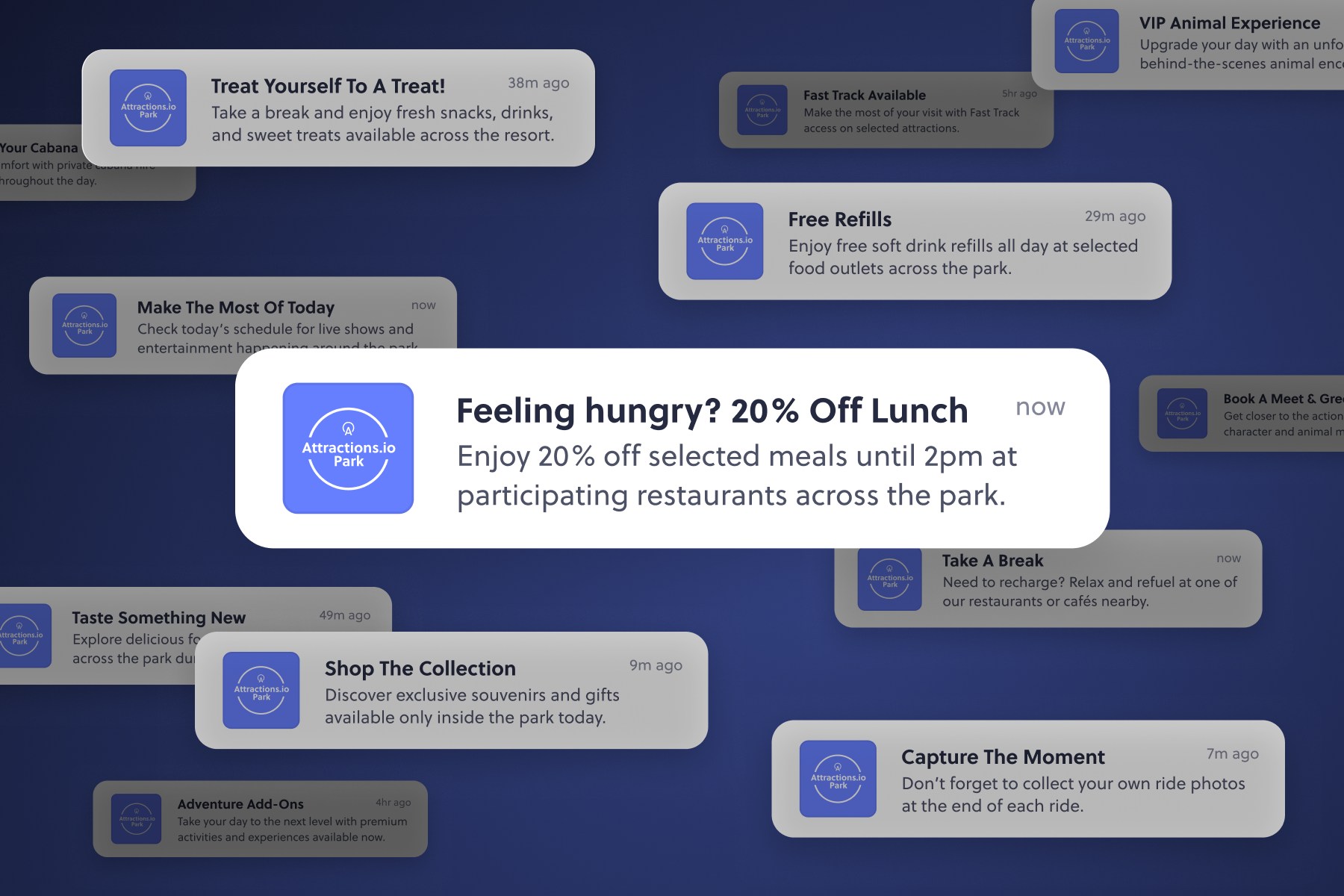
Batch's benchmark of mobile engagement across sectors found that contextual push notifications, triggered by what a user has just done, achieve an average open rate of 14.4%, against 4.19% for generic campaigns sent to broad segments. The same message, moved to the right moment, performs at more than three times the rate. Given that nearly every guest walks through the gate carrying a smartphone, the channel for reaching them inside those windows already exists at every attraction.
The second reason the on-site half remains neglected is that the tools have never been there. The commercial stack our industry has built over the past two decades is almost entirely pre-arrival: booking engines, CRMs, email campaigns, paid acquisition. All of it aimed at the guest who hasn't arrived yet. The moment they walk through the gate — the hours when they're most engaged and the operator has the most influence — the toolkit doesn't look fit for purpose. You can't improve something if you don't even have the tools to attempt it.
As important as timing is, it's nothing without relevance, because a perfectly timed notification offering a family of four a discount on a couples' spa treatment can create more damage than doing nothing at all.
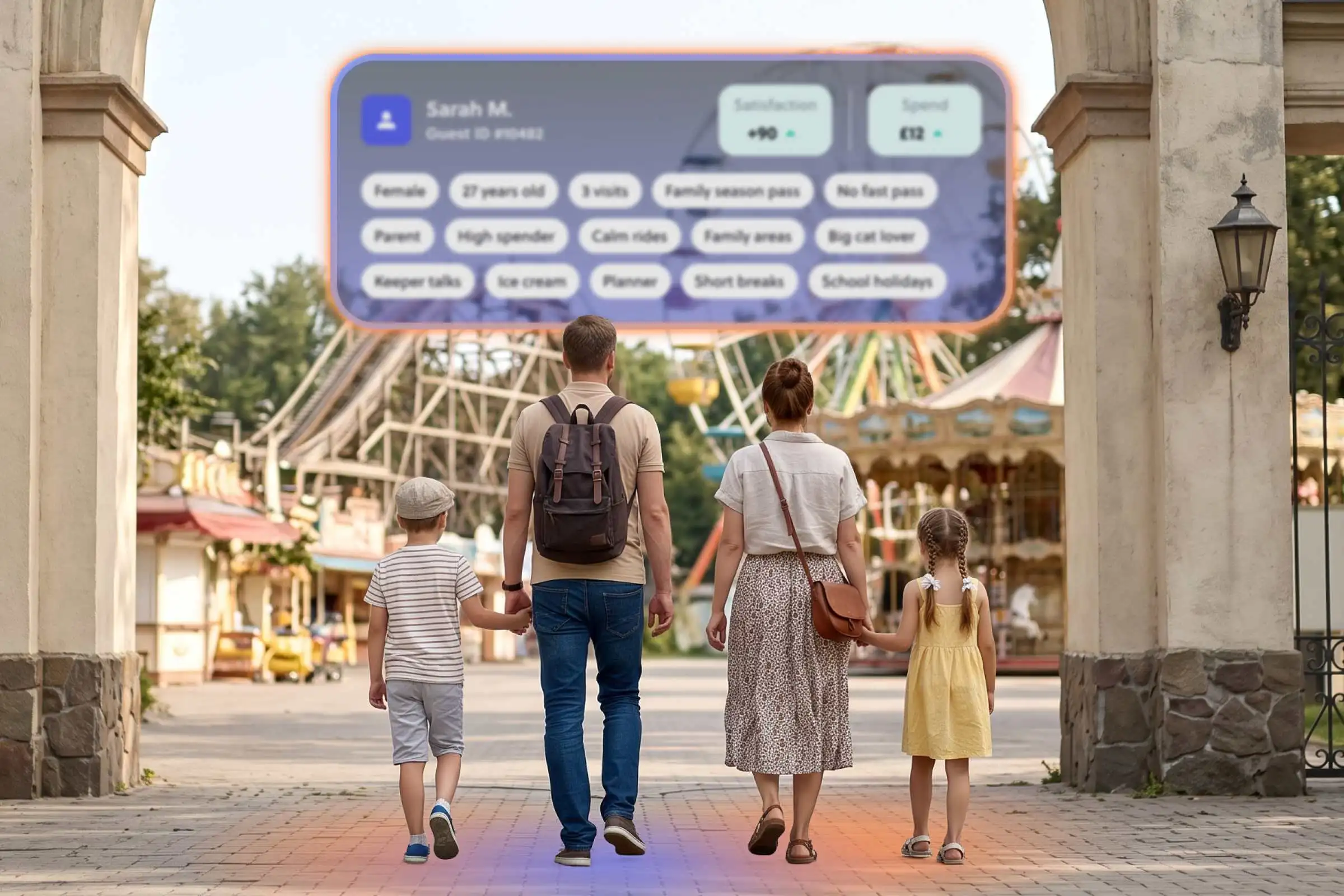
Every guest already produces the signals needed to get this right: the ticket they bought, their visit history, who they're with, what they've purchased today, even the weather when they arrived. What's changing now is that AI is making it practical to weigh those signals for one guest, in real time, and decide what they should see next, then do the same for every other guest in the venue simultaneously. That's the part no operations team could ever do manually, however capable, which is why the industry built its approach around the best available alternative: create a campaign for a segment, schedule it, and refine it over time. It was a sensible way to operate within that limit, but that limit has gone.

Picture a family arriving late morning with rain forecast within the hour. They’re directed towards a nearby indoor show suited to their children, keeping the visit on track. By midday, they’re forty minutes into a queue when an offer to skip the next one reaches them, at precisely the moment the time saved feels worth the price. As lunchtime approaches, they receive a prompt for their usual burger, salad and kids meals from the stand with the shortest line, ready to confirm in one tap — capturing a sale that friction might otherwise have lost. These aren’t new products or new prices. They’re existing offers presented when they are most relevant and most likely to convert. Now imagine identifying and acting on those revenue opportunities for every party across the venue, in real time. That’s what’s possible for the first time.
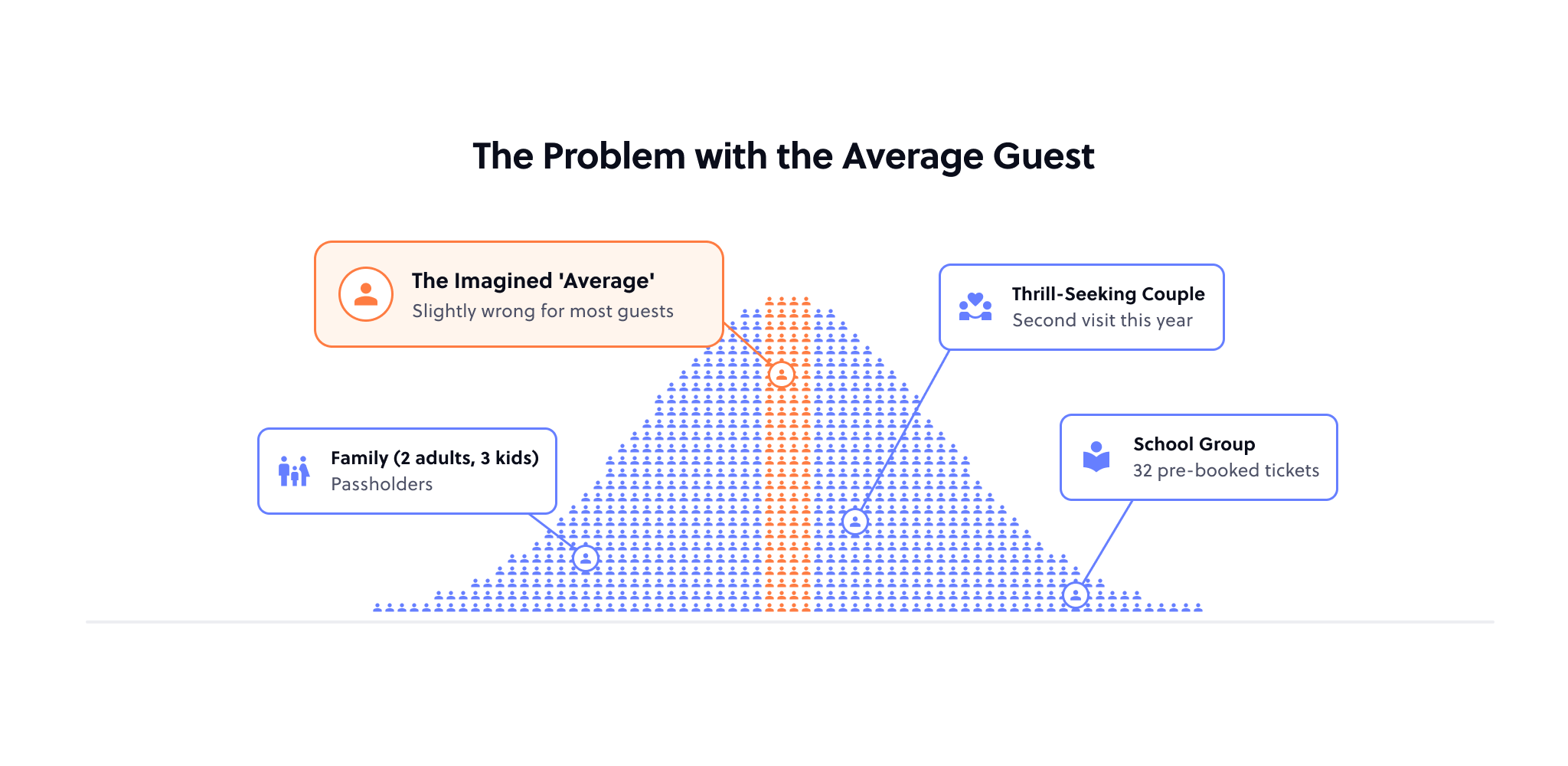
A campaign optimised for the middle of the bell curve is, by definition, slightly wrong for almost everyone. One-to-one decisioning removes that, and improves as it learns, which is why I think it will do more for per-capita spend over the next few years than pricing or discounting strategy could on their own.
Attendance will remain the number everyone watches, but it will remain the number operators have least control over. A nervous economy or a rainy forecast can undo a marketing plan in a heartbeat. What each guest spends once inside is a different kind of number.
That number responds directly to decisions an operator can make for guests, one moment at a time. And for the first time ever it's possible to do it at scale. The operators already growing revenue through a challenging period for attendance suggest the second half of the business was the more dependable half all along.
How can attractions grow revenue when attendance is flat or falling?
When attendance is flat, the revenue attractions can still grow is per-cap spend: what each guest spends once inside on food, retail, experience upgrades and memberships. It makes up more than half of attraction revenue and, unlike attendance, it responds directly to decisions the operator controls, guest by guest.
What is per-cap spend?
Per-cap spend (per-capita spend) is the average amount each guest spends beyond their ticket, across food, drink, retail, experience upgrades and membership. It measures what a visit is worth rather than how many visits there are, which makes it a dependable growth lever when footfall is hard to increase.
How much of an attraction's revenue comes from admissions?
Admissions account for roughly 46% of attraction revenue, with the other 54% coming from in-visit spending on food, retail, experience upgrades and memberships (IAAPA benchmark). That means around half of the commercial opportunity begins only after a guest has decided to visit.
Is discounting a good response to falling attendance?
Discounting can lift the headline attendance figure, but it sells the same day for less and often attracts lower-value guests who spend little inside. It can also reset guests' price expectations in ways that are hard to reverse, shrinking the very revenue it was meant to protect.
Can attractions increase per-cap spend without raising prices?
Yes. Guests are usually willing to spend more than they do, and whether they actually spend comes down to timing. The willingness to buy a queue-skip, a photo or a membership lives inside narrow windows during the visit, so reaching the right guest in the right moment lifts spend without touching the price.
Why does timing matter so much for in-visit spending?
In-visit decisions are made in the moment: a photo bundle appeals most as a family leaves, a queue-skip while they're still in the queue. Contextual messages triggered by what a guest has just done consistently outperform generic scheduled campaigns, which is why timing, not just price or product, drives per-cap.


.jpg)