
Our industry has spent decades perfecting the guest experience: the rides, the animals, the shows, the food, the atmosphere, the welcome at the gate, and the moments families remember long after they leave. But when it comes to digital, most investment has gone into a much narrower challenge: getting guests to book, pay and enter.
Far less has gone into the digital experience of the visit once they are inside, and that is where a large share of revenue sits untouched at almost every attraction. It is the money a guest would happily spend after the ticket is bought.
When attendance stagnates or falls, and with so much of the cause outside anyone's control, the instinct is to chase the gate number even harder. Spend more on acquisition, or discount your way back to target. For years, that was the lever attractions could reliably pull, and it is still where most marketing effort goes.
The trouble is that attendance is the number you control least. A nervous economy or a poor forecast can undo an admissions marketing campaign with one rain icon or one bad-news headline. The instinct to discount would then be strong, but that carries its own cost.

It fills the gate by selling the same day out for less, lifting the headline number while potentially reducing the quality of every visit. In the last three years, the share of guest reviews mentioning queuing and crowding has roughly doubled, as attendance has outpaced the capacity to handle it. Try to push more through the gate than your attraction can comfortably handle, and the day gets worse, usually meaning less spent inside.
The good news is that attendance was only ever half the business.
Admissions typically account for 50 to 60% of an attraction's revenue. The rest is what guests spend once they are inside, the per-cap spend, like food, retail, experience upgrades and memberships. That is the part you can control and grow, whatever the gate does.
It grows when the guests already on site spend a little more each, like the second coffee or the membership a regular would have bought if anyone had asked.
That per-cap is now a reliable growth lever operators can actually pull, but that raises the question…
Guests are usually willing to spend more than they do. Whether they actually spend comes down to timing, because the impulse to spend lasts only as long as the moment that prompts it.
A family that has queued for forty minutes would pay to skip the next queue if the option reached them while they were still standing in line. The ride photo bundle would most likely be bought as a memento as the family is leaving, if they were reminded at the right time. A guest on their third zoo trip of the year is an obvious candidate for an annual pass, if anyone clocks the pattern and asks.

It's fair to say most attractions already do a version of this. There are email lists and a calendar of campaigns, and they have a place, like opening a season or bringing back guests who have drifted away. The limiting factor is timing. A campaign is planned and sent to a segment; it’s a blunt tool. While the moments that grow per-cap happen on the day, one guest at a time and are surgical. By the time an email lands, that moment has passed.
Picture a single family across one day, and a visit that keeps up with them.
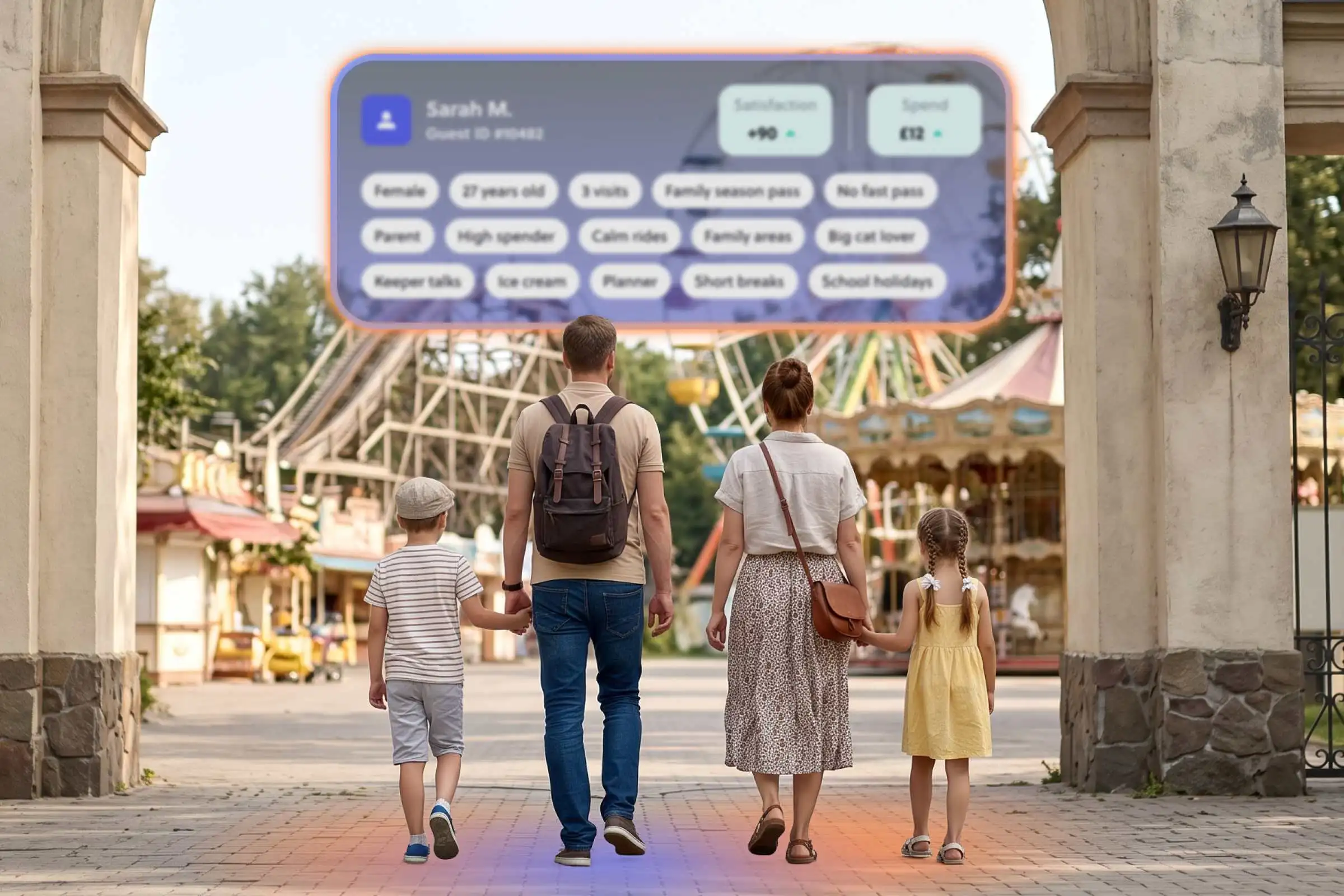
They arrive late morning. Rain is forecast between 11 am and midday, and the most popular attractions already have queues, so the first thing they are prompted to is an indoor show at 11:15, a five-minute walk from the entrance and suited to the children in their party. By midday, they are in a forty-minute queue anyway, and the option to skip to the front of the next one appears while they are standing in it, at a price that feels fair for the time it saves. Early afternoon, with this their third visit since spring, they are offered the membership that would already have paid for itself. On the way out, tired and happy, they get a reminder about the photo opportunity they had taken earlier in the day, and it goes in the bag as a reminder of an amazing day.

Picturing this for one family is easy. Doing it for them and every guest at once is the part that has never been possible. Now it can be done.
For years, reaching guests one-to-one at scale was beyond anyone, however hard operators worked at it. Knowing the right thing to offer a guest means weighing where they are, what they have done, what is open, what has a queue, what suits their party, the weather, how long they have left and more. No team could hold all of that for one guest, let alone thousands at once. Even the biggest operators couldn't, so everyone did the only thing that scaled. Batch the offer, pick a broad segment, schedule it and pray.
AI can now take in the operational and behavioural signals around a single guest, weigh them and decide their next best moment in real time, then do the same for every guest at once. It does that by drawing on the systems an attraction already runs rather than replacing them: the ticketing, the queuing, the point of sale, the live operational feeds and the guest's own history, pulled into a single decision about what the guest should see next. Then it delivers that decision to them in the moment it's useful: a push notification offering to skip the queue while they are still standing in it, or the membership prompt waiting on the app home screen that afternoon.
Spend what you like at the gate. That number will always be at the mercy of things you cannot control. How much each guest spends once inside is now yours to influence, and this is the year to do it.

How much of an attraction's revenue comes from admissions?
Admissions typically account for 50 to 60% of an attraction's revenue. The rest is per-cap spend: what guests spend once they are inside on food, retail, experience upgrades and memberships. Because in-visit spend grows without selling more tickets, it is usually the easier half of revenue to increase when attendance is flat.
What is per-cap spend?
Per-cap spend, short for per-capita spend, is the average amount each guest spends beyond their ticket, across food, drink, retail, experience upgrades and membership. It measures what a visit is worth rather than how many visits there are. Lifting per-cap raises revenue without adding pressure on capacity, which makes it a dependable lever when footfall is hard to grow.
Is discounting a good response to falling attendance?
Discounting can lift the headline attendance number, but it sells the same day for less and can crowd the experience. The share of guest reviews mentioning queuing and crowding has roughly doubled in three years. A busier, cheaper day often means guests spend less inside, so discounting can shrink the very revenue it was meant to protect.
How can attractions increase revenue when attendance is down?
When attendance is down, the revenue you can still grow is per-cap spend, the money guests spend once they are inside. The opportunity is timing. Guests are usually willing to spend more, but the offer has to reach them in the moment they would say yes. A scheduled email usually arrives after that moment has passed.
IAAPA Quarterly Outlook Survey, Q2 2026
Accesso’s Voice of the Visitor: 2026 Industry Benchmark Report
Attractions.io, The Attraction Marketers' Guide to Revenue Growth in 2026